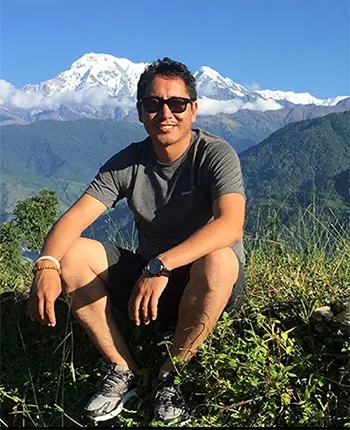

Sacred Garden of Lumbini: Where the leader of world peace Was Born
Written by

There are places in the world that do not speak loudly, yet they stay with you forever. Lumbini is one of them.
Located in the peaceful plains of southern Nepal. Lumbini is known as the birthplace of Siddhartha Gautam (Lord Buddha). But beyond title, monuments, history, Lumbini is most and foremost a human place. It is where a child was born, where a mother rested, and where a journey of understanding humanity quietly began. Lumbini is not just the birthplace place of Lord Buddha. It is the birthplace of calm for the human heart. As you walk near the sacred pond (Pushkarini) and ancient temple. You began to understand why Buddha’s message was about compassion, kindness, and peace. The land itself teaches it without words.
When you arrive in Lumbini, the first thing you notice is not a grand structure or loud, but it’s calm. The air feels lighter, the surroundings softer. The world seems to slow down in its own. People lower their voices without being asked. Everyone begins to move gently, looking inwards into themselves. Standing in Lumbini, you don’t feel like a visitor. You feel like a listener. Lumbini doesn’t ask you to believe in anything. It only asks you to feel. As you walk around the sacred garden, you can see monks and nuns doing chanting and meditation, that makes peaceful environment.
Lumbini is more than just a religious or a historical site. It is a place of pristine natural environment, sanctity, harmony, peace, and enlightenment. Whether you are looking for religious inspiration, historical knowledge, or simply a tranquil retreat, Lumbini offers an incredible experience.
Brief History of Lumbini
Lumbini lies within the Terai region of Nepal. Lumbini was discovered by chance when a rubble mound surmounted by a modern shrine to Rupadevi (Maya Devi) was visited by Dr. Fuhrer of the Archaeological Survey of India and General Rana, Governor of Palpa, in 1896, where they discovered the Ashoka Pillar with an inscription recording the name Lumbini as birth place of Buddha.
The Pali commentaries explain that Queen Maya wanted to have her child at her parents’ house in Devadaha. On her journey almost midway, there was a beautiful garden where she stopped to take some rest due to labor pain, and so gave birth to a baby boy in that garden called Lumbinivana, named Siddhartha Gautama, the prince of Kapilvastu. Evidence suggests that this same route served as an ancient highway connecting to Takshashila (Takshashila in present-day Pakistan) via Lumbini, Tilaurakot, Gotihawa, and Srabasti. From Buddha’s birth, this place holds a great significance, it is known to be inhabited by Buddhist Monks and visited by many Buddhist pilgrims.
Maya Devi Temple provides a unique and valuable insight into the structure and character of the earliest Buddhist shrines. It holds a remarkable 4th-century sculpture depicting the birth of Prince Siddhartha (the future Buddha). The carving shows Queen Maya Devi at the moment of giving birth, steadying herself by grasping a tree branch. Her sister Gautami Prajapati stands beside her in a supportive pose. The infant prince appears standing on a lotus flower, while two divine beings hover nearby to receive the newborn Prince Siddhartha Gautama. The red sandstone sculpture is said to have been carved by the Mathura School of Art in the 4th century.
Recent excavations beneath the Mayadevi Temple revealed the remains of a timber structure dating back to the 6th century BC. This structure is believed to be an ancient tree shrine, suggesting that the site was already a place of active worship and pilgrimage
shortly after the Buddha’s departure from the world. At the core of the Maya Devi temple is a conglomerate sandstone slab that pinpoints the precise spot where Prince Siddhartha Gautama (the Buddha) is believed to have been born. Some scholars believe that the “marker stone” pinpointing the exact birth spot may have been placed by local residents before Ashoka’s arrival to commemorate the event for future pilgrims.
Later, Ashoka ordered the construction of a platform using burnt bricks to protect the exact spot of the Buddha’s birth (the “Marker Stone”).
Ashoka also built four stupas (memorial shrines) during his pilgrimage to Lumbini. The ruins of these ancient stupas and monasteries, dating from the 3rd century BC onwards, can still be seen in the sacred garden area today. These ruins have meditation cells, prayer halls, bath house, which shows how monks and devotees formed a living sacred garden around the Buddha Birthplace.
Later, General Keshar Shumsher organized extensive excavations, revealing the remains of ancient stupas and monasteries, restoring the sacred pond, and reconstructing the Maya Devi Temple. This is where we get the iconic old Temple with steps leading to the inner shrine floor and a huge tree behind the temple.
Modern Lumbini constitutes both ancient relics and modern peacemaking efforts, blending together in partnership. Constructed around the very area where Buddha was born, the Maya Devi Temple is the holiest place in Lumbini. Not very far away, the Pushkarini Pond, where Queen Maya is believed to have bathed before giving birth, adds to the holiness of the place. Not only has Lumbini been a great source of religious significance, but it has also been turned into an international representation for peace and coexistence.
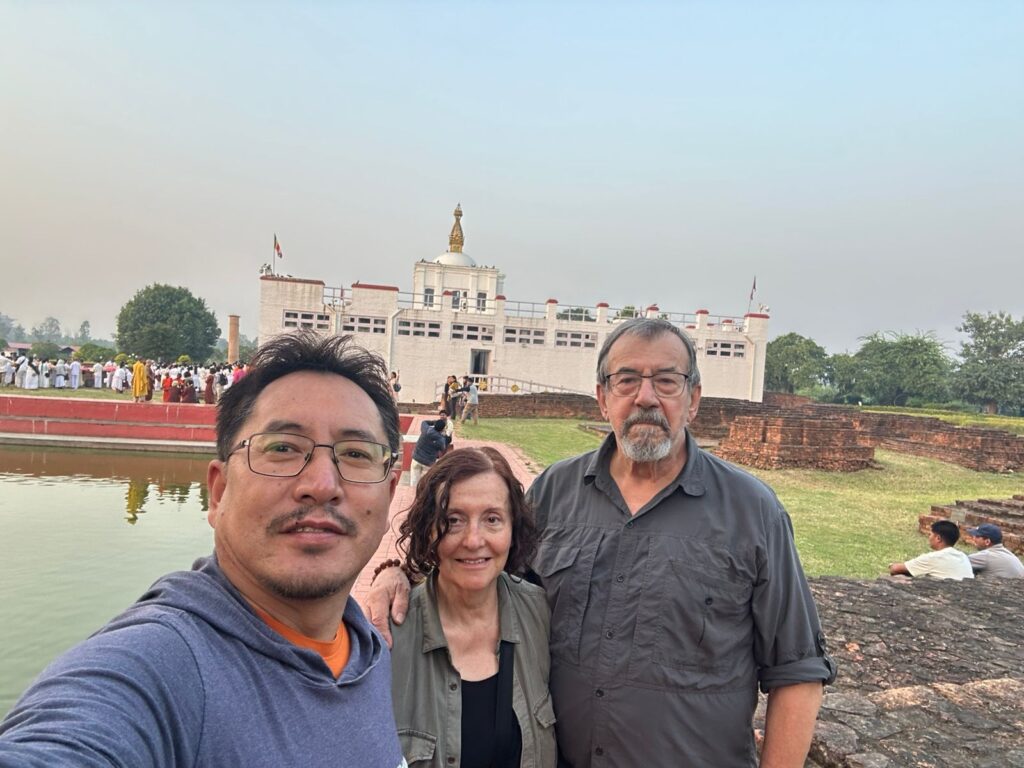
How to get to Lumbini?
Traveling to Lumbini from Kathmandu is like going from the hectic capital of Nepal to the calm birthplace of Lord Buddha. Here’s how one can reach there:
- By Flight
The quickest way to get to Lumbini is to fly into Gautam Buddha International Airport, Bhairahawa, located just 22 km away from Lumbini. It takes approximately 30 minutes by flight. From the airport to Lumbini, you can hire a taxi, which takes about 25–30 minutes to reach Lumbini.
- By Road
By road, it is a scenic route through Nepal’s countryside, and it is cheap. Tourist Buses depart daily from Kalanki or Gongabu Bus Park in Kathmandu around 6:00 AM takes about 8 to 10 hours.
Where to Stay in Lumbini
Budget Options:
Annand Inn, Five Elements, and Lumbini village lodge are some family-run guesthouses and lodges near the market area of Lumbini
(Mahilawar) that offer clean, simple accommodations and local hospitality.
Luxury Options:
Hokke Lumbini and Hotel Kasai offer traditional Japanese-style stays, and Buddha Maya Garden by KGH offers a traditional Nepali experience in Lumbini offer forest resort-style facilities such as swimming pools, spas, and wellness centers. These often feature all-inclusive packages including private guided tours.
Travel Tips for Maya Devi Temple, Lumbini
- Entry Fees: Entry to the Sacred Garden of Maya Devi Temple is as per the Lumbini Development Area, based on your nationality.
- Clothing: Modest attire is advised, too revealing clothes are not recommended. Light cotton in summer and warm layers in winter, with good socks, as shoes are not allowed in their sacred area.
- Local Etiquette: Photography may be restricted in certain Speaking loudly or playing any music is not allowed.
- Meditation: Meditating in the sacred garden is a Divine experience. Make sure to carry a cushion or yoga mat
- Access and Entry: Recommended to reach Gate No 5, from there Maya Devi Temple is within walking distance.
- Pro tip, take a boat from the parking area of Lumbini Development Trust and ride in the central canal with divided the Master Plan of Lumbini, which holds more than 30 monasteries of the Mahayana and Theravada traditions.
Thailand, Myanmar, China, Korea, Peace Pagoda, more about these monasteries showcasing their own unique culture, traditions, and architecture of Buddhist countries.
Dhamma Janani Mediation Center
Vipassana, which means to see things as they really are, is one of India’s most ancient techniques of meditation. It was taught in India more than 2500 years ago as a tool for liberation from the world of misery. Dhamma Janani, meaning “Mother of Dhamma,” is a serene Vipassana meditation center in Lumbini, the Buddha’s birthplace, operating since 2000. Its donation-based 10-day course is free, funded by donations from past students, ensuring accessibility. Offers structured 10-day residential retreats, teaching the basics of the technique for lasting benefit.
Cambodian monastery
Cambodian Monastery in Lumbini is built in an architectural design matching the famous Angkor Wat. The charming monastery is surrounded by a square railing, each having four 50m green snakes. The large compound has an outer wall covered with beautiful and intricate designs. It is an amalgamation of colorful fantasy and spiritual forces, making it one of the most fascinating temples in the region.
Sri Lakan Monastery
This monastery serves as a spiritual home for Sri Lankan pilgrims and was one of the early international contributions to the Master Plan. Surrounded by water canals and steep stems leading to a shrine where the Bodhi tree is planted, it’s beloved to be part of a tree with the same origin under which Buddha attained Nirvana. Sri Lankan monastery has large wall paintings depicting different events in the life of Buddha in the Theravada style of art.
Bodhi Institute (Peace Grove Nunnery)
A small residential Buddhist community of 21 girls between the ages of 7 and 31, located inthe Theravada Section of Lumbini Development Trust, the site of the Buddha’s birth. The Peace Grove Institute provides a quasi-monastic, socially safe space for girls, which allows them to delay marriage and to continue their education. This institute is an ongoing creation of the Peace Grove girls themselves. It’s a mixed modality of female agency of the Peace Grove nuns within the disciplinary norms of female Buddhist monasticism, and within the educational and cultural environment of Peace Grove nunnery
Dharmodaya Sabha (Swayambhu Style Stupa)
Dharmodaya Sabha Nepal was established in 1944 in Sarnath, India, to promote Buddhist faith and protest against the expulsion of monks by the autocratic Rana regime. It is a newly constructed, beautiful temple of Theravada Buddhism in Nepal. The Large dome-shaped stupa houses a standing large statue of Lord Buddha in the center. Moreover, there are small statues of the Enlightened One in triplicate around the wall of this temple. They have an attached museum depicting the life history of Buddha through beautiful pictures, prominent monks and nuns of Theravada and events related to the growth of Theravada in Nepal.
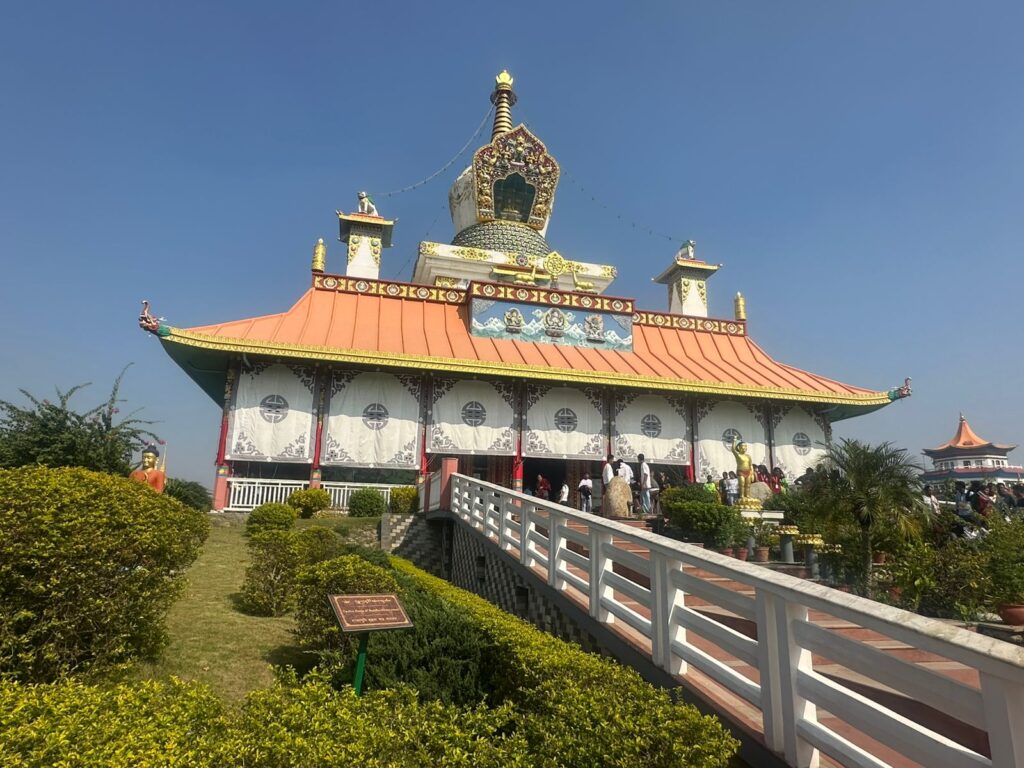
Dharma Swami Buddha Vihara
A Shakya monastery in Lumbini, Nepal. It was built in the early 1970s by the late King of Mustang (Chogya Trichen Rinpoche). It hosts the annual Shakya Monlam Puja, where 60+ resident monks perform traditional Tibetan rituals and chants for world peace.
The Royal Thai Monastery:
Is located in the East Monastic Zone, close to the north end of the pond in Lumbini. It is one of the international monasteries built in Nepal, funded by the government of Thailand. The wonderful Thai-style monastery is built from shiny white marble. Royal Thai Monastery in Lumbini is an imposing and stunning wat-style (Thai Monastery style) monastery dedicated to Buddhist practices. The beautiful designs and carvings on the temple wall make this place a must- visit. Architecturally, it is very Thai, but there is an absence of the usual decorations such as coloured glass. The exterior of the building is completely white and has some beautifully crafted Naga style support columns for the overhanging roofs.
Myanmar Golden temple:
The Myanmar Golden Temple is one of the oldest structures in the compound. There are three prayer halls- the most impressive is topped by a corncob- shaped shikhara (tower), styled after the temples of Bagan. Also within the temple grounds is the Lokamani Pula Pagoda, a huge gilded Stupa in the southern Burmese style of architecture. The temple is dedicated to Lord Buddha.
Zhong Hua Buddhist Monastery (Chinese Temple):
Zhong Hua Chinese Buddhist Monastery, popularly known as the China Temple, is an elegant Buddhist Monastery in Lumbini. The Chinese Temple is situated just in front of the Korean Buddhist temple in the West Monastic Zone in Lumbini. It is a stylish Buddhist Monastery in Lumbini built in a Pagoda style. The Monastery looks like the famous Forbidden City of China. As one enters, the perfectly manicured internal courtyard fills the heart with peace and joy.
Korean Temple:
All of the monasteries inside Lumbini have their own unique quirkiness made of strong religious beliefs. The feeling of excitement as you make your way into the Korean Temple is something that will brighten your whole day. Here you can find many interesting things to do in Lumbini, Nepal.
Dae Sung Shakya Sa, popularly known as the Korean Temple, is a Buddhist Monastery in Limbini. The impressive structure is built in a Korean style of architecture and has colorful murals on the ceiling. It even offers a community sleeping area as well as three meals a day to visitors for a few days at minimal cost NOR 500 per day. Meditating in the courtyard full of monks and pilgrims is a peaceful and refreshing experience.
World Peace Pagoda:
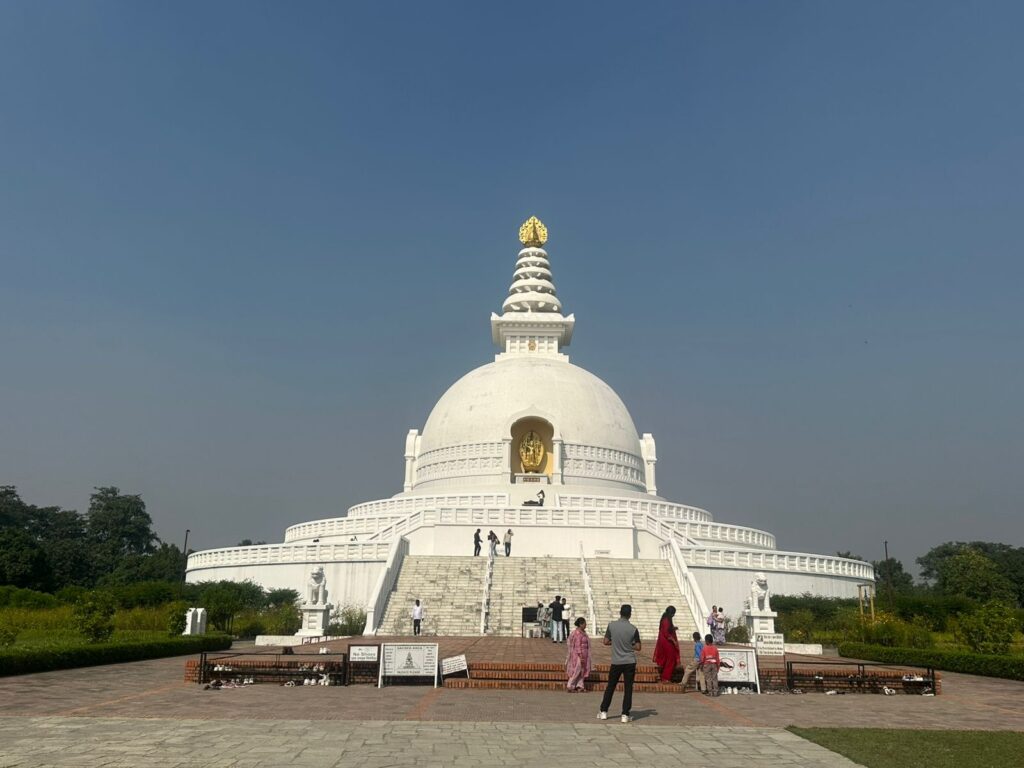
Located outside the main compound, but easily accessible by bike, the impressive, gleaming White World Peace Pagoda, one of the world’s greatest stupa was constructed by Japanese Buddhists at a cost of US $ 1 million. The shining golden statue depicts the Buddha in the posture he assumed when he was born. The Pagoda acts as the starting point on the central axis of the Lumbini Master Plan, the other end being the Mayadevi Temple. The distance from the Pagoda to the temple is about 3.2 km. The monument is colored white with traditional style building, which is a symbol of peace and a famous tourist attraction in Lumbini.
Lumbini Crane Sanctuary
The Lumbini Crane sanctuary protected land of 6 Square Kilometer aimed to offer a natural home for rare sarus cranes in and around the wetlands of the area. The protection area is situated near the World Peace Pagoda outside the main complex of the Lumbini Monastic Zone. It is one of the most unique attractions and a worthwhile place to visit in Lumbini.
Cranes hold a special place in the tales related to Buddha. So naturally, they have been devoted a sanctuary, dedicated entirely to their preservation, which also serves as a conservation site for a lot of other local birds. It is estimated that there are over 100 pairs of cranes living in the reserve, including the rare species of Sarus Crane.
Plan Your Spiritual Journey to Lumbini Today with Responsible Treks
Related Blogs
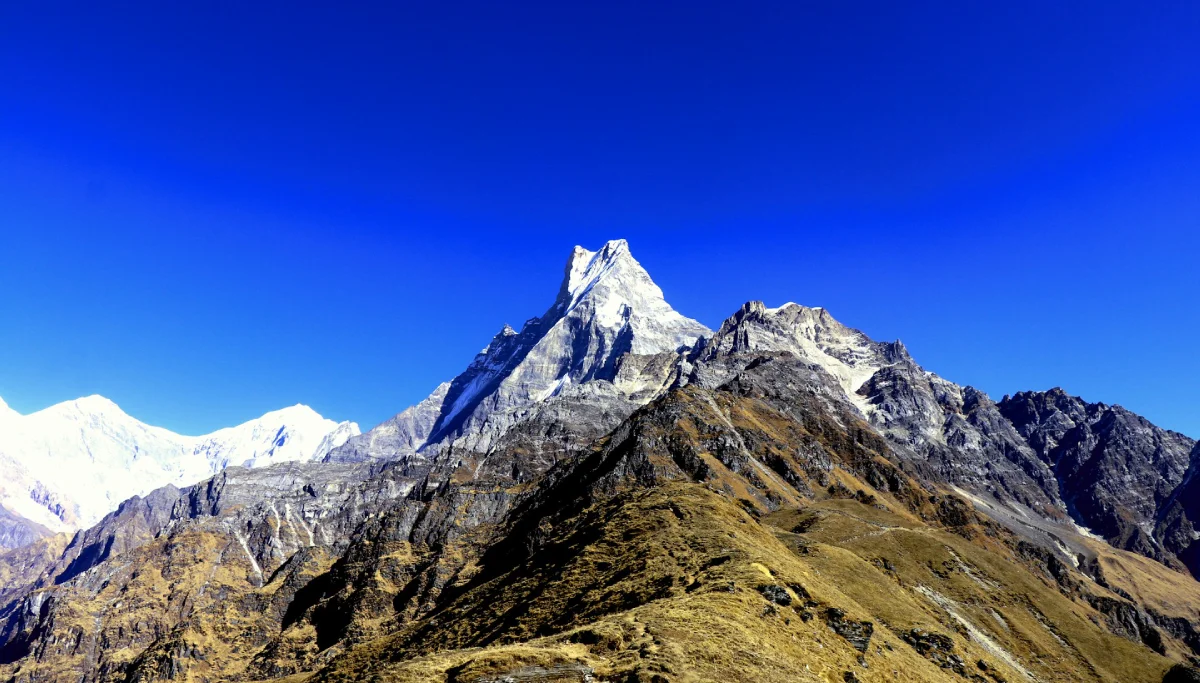
Mardi Himal Trek Guide – Everything You Need About Mardi Himal Trek
The Mardi Himal Trek Guide is your complete resource for planning a short, scenic, and peaceful trek in the...
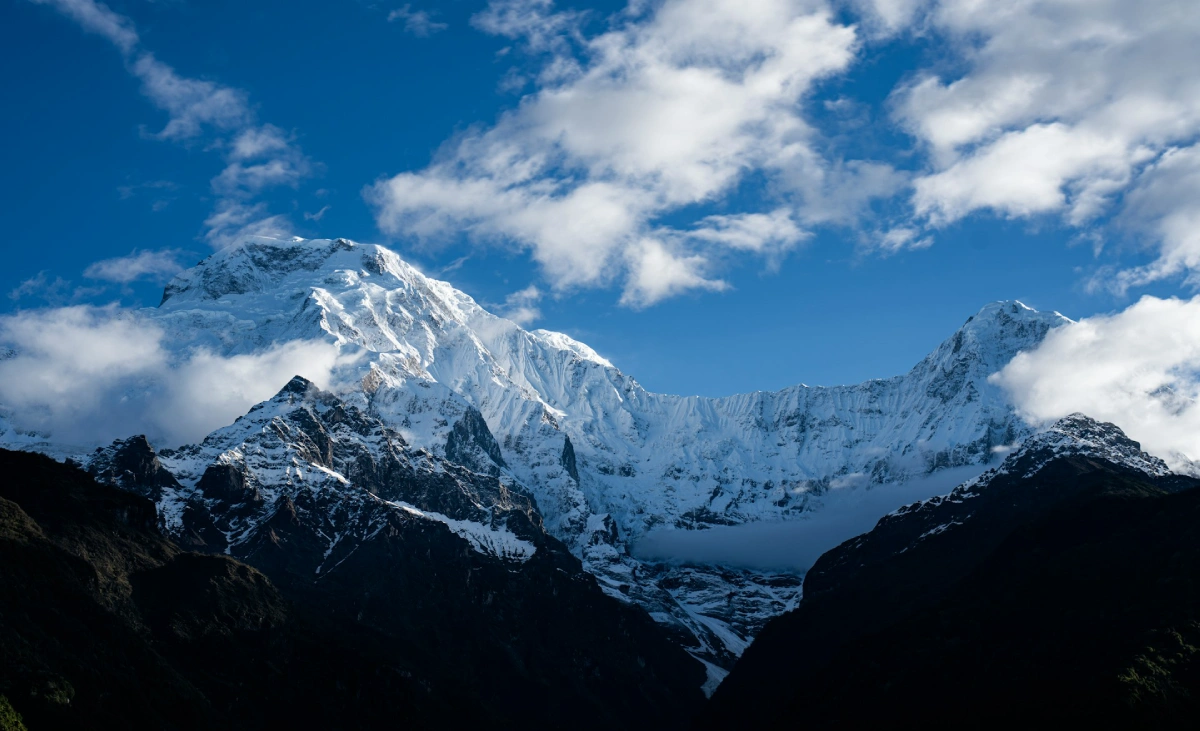
Mardi Himal Trek for Beginners A Gentle Adventure into the Heart of the Himalayas
If you’re new to trekking and want to explore Nepal’s majestic Himalayas, the Mardi Himal Trek for beginners is...
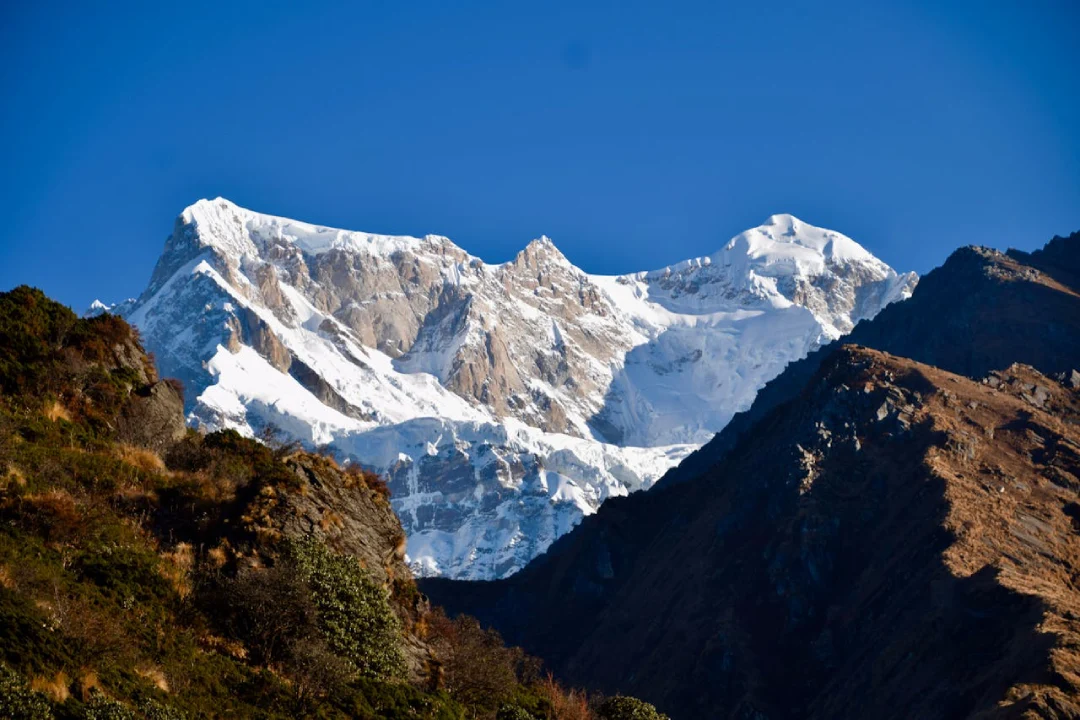
Explore the Short Manaslu Circuit Trek: A Perfect Himalayan Adventure
Manaslu, meaning the spirit in the Sanskrit, is an extraordinary circuit trek. The Short Manaslu circuit Trek is one...
For Queries & Reservations
Travelling with us is flexible, freedom and fun.
We deliver exceptional products at a very good price for you, but not at the cost of the environment or our social responsibilities “travel Responsibly”
+977-9801046333 / +977-1-4813166
info@responsibletreks.com